Partner-led growth · Guide
Partner-led growth for B2B: how to find referral partners who actually send deals
A practical guide to partner-led growth for B2B teams: who to partner with, how to score fit, make the first ask, and get referral partners sending deals.
11 min read
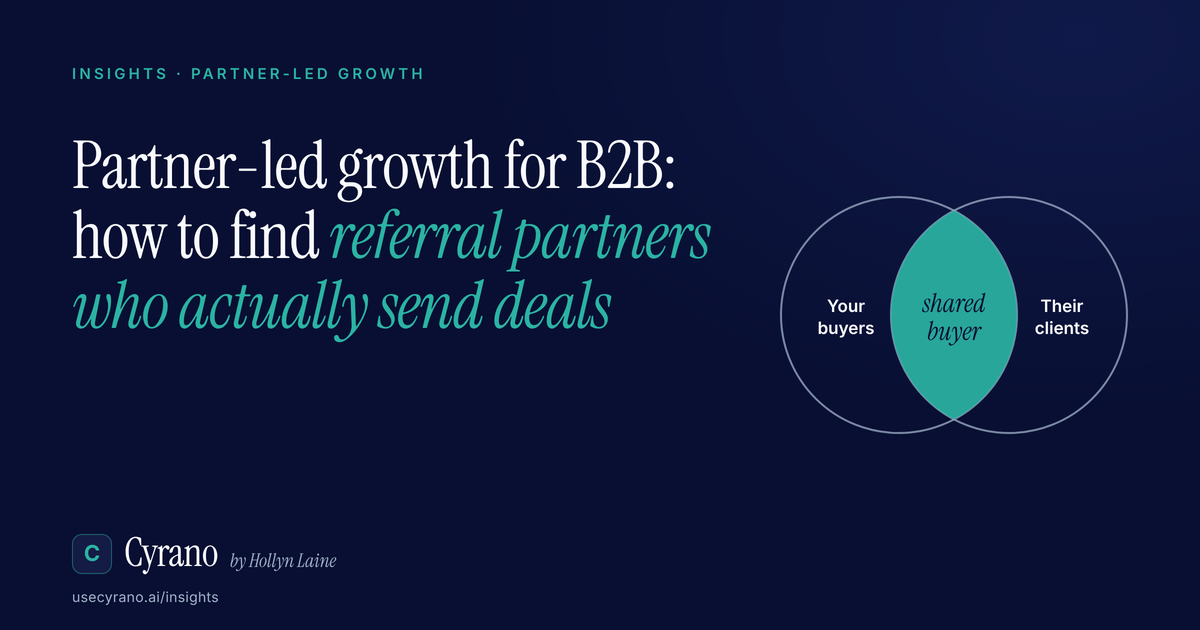
Most referral partner programs I see start the same way. Someone signs up twenty or thirty partners in a quarter, sends a welcome email with a logo pack, and then waits. A couple of partners send an introduction in the first month, one of those turns into a real deal, and by month four the rest haven't been heard from.
Partners usually go quiet for boring reasons. The company picked whoever was easiest to sign, never gave them a reason to bring it up, and had no idea what to measure. All of that is fixable, and most of the fixing happens before you send the first email.
This guide covers how I'd build a partner-led growth motion from scratch. My examples lean toward HR tech, payroll, benefits and the advisors who serve small business back offices, because that's the world I work in, but the mechanics carry over to most B2B companies that sell to the same buyer as somebody else.
What is partner-led growth, and what counts as a referral partner program?
Partner-led growth means a meaningful share of your new pipeline comes through other companies that already have a relationship with your buyer. They introduce you, recommend you, or work a deal alongside your sales team. A referral partner program is the set of agreements and habits that make that happen on purpose instead of by accident, and it can be as light as eight good relationships and a shared spreadsheet.
I'm focused on B2B referral partnerships here, not resellers or affiliates. Picture a payroll company getting introduced to the clients of a fractional CFO firm. Nobody is reselling anything here, and the CFO just says "you should talk to these people" when a client's payroll turns into a mess.
Why bother? The best-known numbers come from Crossbeam's 2023 State of the Partner Ecosystem report, where 526 partnership professionals reported that, on average, deals are 53% more likely to close and close 46% faster when a partner is involved. I'd treat those as directional. They're survey averages, they're self-reported, and partner-involved deals are probably better qualified to begin with.
An older academic study points the same way. Researchers followed about 10,000 customers of a German bank and found that referred customers were worth at least 16% more than similar customers who weren't referred (Journal of Marketing, 2011). That's consumer banking, so I wouldn't promise anyone 16% in B2B payroll. It does match what I've seen, though. Somebody who arrives through a person they trust shows up with less suspicion and more patience, which I get into in warm introductions vs cold outbound.
Start by picking partner types, not partners
Before you build a list, decide which kinds of companies are in the room when your buyer makes the decision you care about. For a payroll or HR platform selling to small and mid-sized businesses, the list usually looks something like this.
| Partner type | Why they send deals | What to check first |
|---|---|---|
| Benefits brokers and agencies | They sit down with the owner or HR lead every year at renewal and hear about admin pain early | Whether they already have a preferred platform they're expected to recommend |
| PEOs and HR outsourcers | Same buyer, and they see companies as they grow out of a bundled setup | They can overlap with payroll, so agree on who owns what |
| Fractional CFOs and bookkeepers | They live in the numbers and notice when payroll or benefits costs look off | Smaller firms have limited capacity and a short client list |
| CPA and advisory firms | Owners ask them "who do you recommend?" all the time | Rules around referral fees (more on that below) |
| Adjacent software such as time tracking, hiring or expense tools | They already sell to the same HR buyer | Their reps are paid on their own product, so intros take real effort |
| Employment attorneys and HR consultants | They get called when something has gone wrong or is about to change | Referrals tend to come in bursts around compliance events |
I'd pick two or three types to start with, not all six. Each one needs a different pitch and a different value exchange. A benefits broker's year revolves around renewal season while a fractional CFO firm's revolves around the monthly close, and running every playbook at once is how programs end up with thirty names and no results.
How to find referral partners
Finding the actual companies is mostly detective work. These are the places I'd look, in this order.
Your own customers and closed deals
Open your last twenty closed-won deals and look at who else was involved. There's often an outside accountant, broker or consultant in the email thread or mentioned in a call note. Those people already influence your buyers, and some of them have probably recommended you without you ever knowing.
Then ask your best customers directly who they rely on for their books, their benefits and their HR questions. Names that come up more than once are your warmest candidates.
Other people's partner pages and event lists
Look at who adjacent vendors list as partners, who sponsors the regional HR and small business events your buyers go to, and who speaks on the panels those buyers attend. A partner page is a free map of companies that are already comfortable being associated with a vendor.
Your network, and your partners' networks
Ask people who know your market who they'd recommend. Once you have one good partner, ask them who else they trust, because a recommendation from a partner comes with an opinion about quality attached. It's usually the best source of sensible introductions you'll find.
How to score partner fit before you reach out
A lot of partner effort goes to companies that looked right on paper: the right industry, a nice website, a LinkedIn post they once shared. I score every candidate on three things before writing a word to them.
Audience overlap. Do they serve the same buyer at the same size? A benefits broker whose clients are mostly 500-to-5,000-employee companies isn't going to introduce you to the 40-person businesses you sell to, however friendly they are. Look at the clients they show off and the language on their site.
Complementary offer. Does what they sell make yours more valuable, or at least sit comfortably next to it? A fractional CFO firm that cleans up a client's books is a natural neighbor for a payroll platform. A company that sells something close to yours is a different conversation entirely, and it's usually a harder one.
Deal size match. This one gets skipped most often. If your average deal is large and their typical client is tiny, they'll send leads that can't buy. If their clients are large and your deal is small, your product won't be worth the effort it takes them to bring it up.
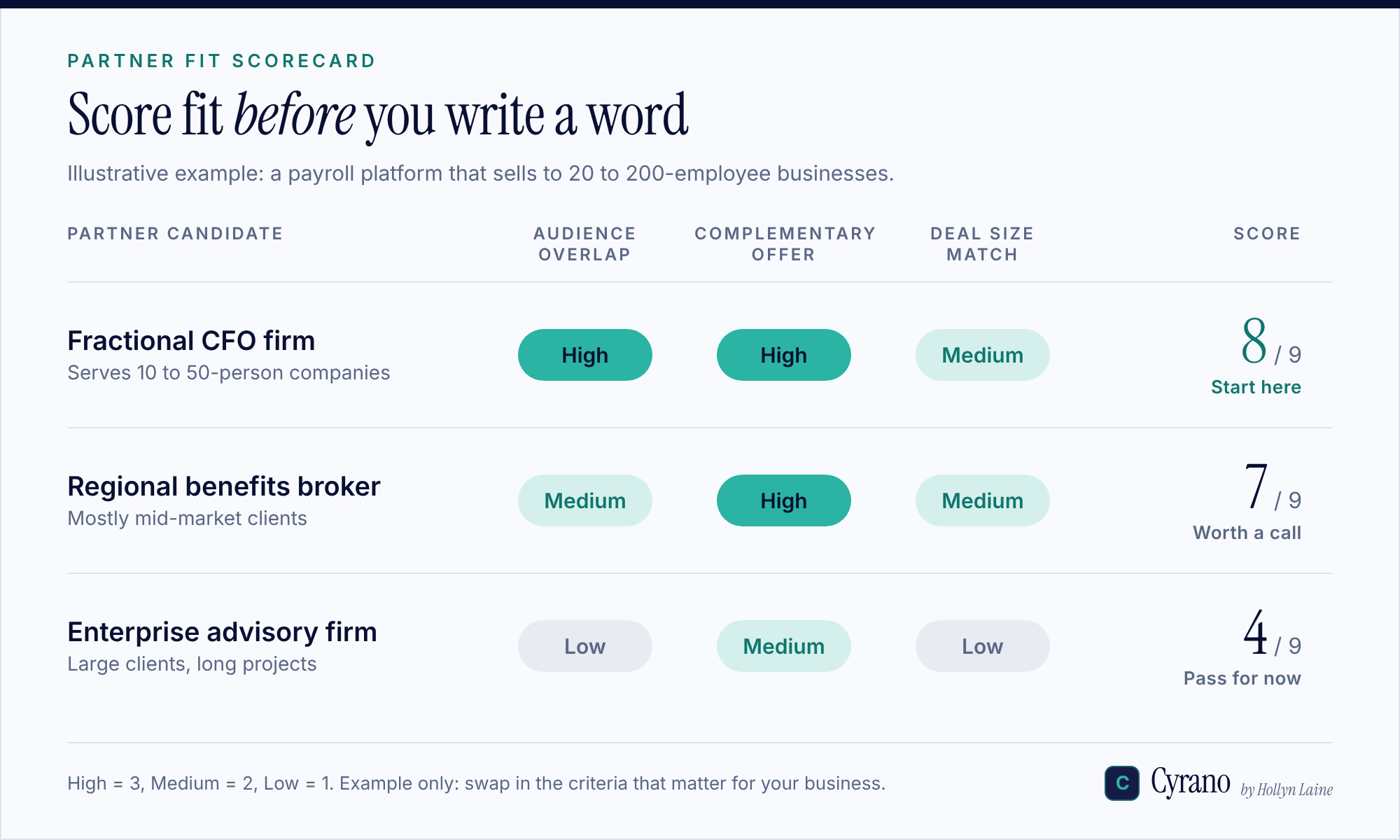
I rate each criterion high, medium or low (three, two or one point), add them up, and spend my time on the top of the list. Then I run two quick reality checks that don't fit neatly in a score. Does this partner already recommend other vendors to clients, and do they have the capacity to take on one more thing? A partner who has never recommended anyone is a much bigger ask than one who does it every week.
How to make the first ask
Please don't open with "can you introduce us to your clients?" You haven't earned that yet, and it hands the partner all the work. What tends to go better is a short note about something you both see in the market, with an ask for twenty minutes.
Hi [First name], I noticed your firm works with a lot of growing companies in the 20 to 100 employee range. We hear from the same kind of company when their payroll and benefits setup stops keeping up, and I thought we might be useful to each other. Do you have 20 minutes next week to compare notes? I won't pitch you. I'd mostly like to hear what your clients ask you about.
On the call, spend most of your time listening. Ask what their clients complain about that they can't fix themselves, and what happened the last time they recommended another company. You're finding out whether the overlap is real and what a good introduction looks like to this particular person.
Then say what you can do for them first. If you know a client or a peer who'd value their services, make that introduction before you ask for anything. It changes the tone of every conversation that follows.
When you do ask, keep it small and specific. Something like a single introduction to a client who recently mentioned the problem is plenty, and I'd offer to write the note for them to forward. LinkedIn's own sales team makes the same point in its guide to earning referrals: give the person a message they can reuse so the favor costs them almost nothing.
How to structure the value exchange
Every recommendation spends some of a partner's reputation, so the exchange has to make sense for them. These are the options I see most.
- Reciprocal introductions. You send them clients or contacts who need what they do. It costs nothing and works best when your customer bases genuinely overlap.
- A referral fee or revenue share. Common in some industries and awkward in others. CPAs are the example to know about. The AICPA code bars commissions for recommending products to some clients, such as audit and review clients, and requires disclosure in the cases where they're allowed (see section 1.520). Some accountants decide it's simpler to take no fee at all, so ask before you put one on the table.
- Co-marketing. A joint webinar, a shared checklist, a guest post. It suits partners who care more about visibility than money.
- Something for their clients. A free audit, priority onboarding, a perk the partner can pass along so they look generous to the people they serve.
I don't have a favorite, because it depends on the partner and it's often a mix of two. What I'd insist on is writing down four things for every partner, even in a one-page note: what counts as a referral, how long you credit them for it, who owns the relationship with the client, and how fast you'll respond. When partnerships turn sour, it's usually because one of those four was left vague.
How to activate referral partners
Signing a partner is the easy part. Getting them to mention you at the right moment is the job, and it breaks down in predictable ways: they can't describe what you do in a sentence, they don't know when to bring you up, they're nervous about sending a client to a company they don't know well, or they forget. So fix those directly.
Give them a trigger. Something like "if a client says they're outgrowing their payroll provider, or you're hearing complaints about open enrollment, that's when to mention us." A trigger beats a feature list because it tells them when to act.
Make the intro easy. Write the two-sentence blurb for them, and ask the prospect for permission before you take it any further. A double opt-in keeps the partner's name safe and keeps the prospect from feeling ambushed.
Make the first one go well. Answer the same day and treat their referral like a VIP, even if the company is small. A partner who watches one introduction go badly may not try a second.
Close the loop. Tell them what happened to every intro, including the ones that went nowhere. Partners who hear nothing assume nothing happened, and they stop trying.
Keep a cadence. Thirty minutes a month with your top partners is enough, and a quarterly "who should we meet next?" conversation tends to produce the next round of introductions.
Be honest about the quiet ones, too. If a partner hasn't done anything after a few months of real effort, move them to a lighter touch and spend the time elsewhere.
Which partner-led growth metrics to track
Partner-sourced revenue is the number everyone wants, but it shows up late, and with a long sales cycle you may wait months to see it. I track a few earlier signals alongside it: how many partners made at least one introduction in the last 90 days, how many introductions each active partner sends, how often an introduced person takes the meeting, and how many meetings become real opportunities. Then comes time to first deal for new partners.
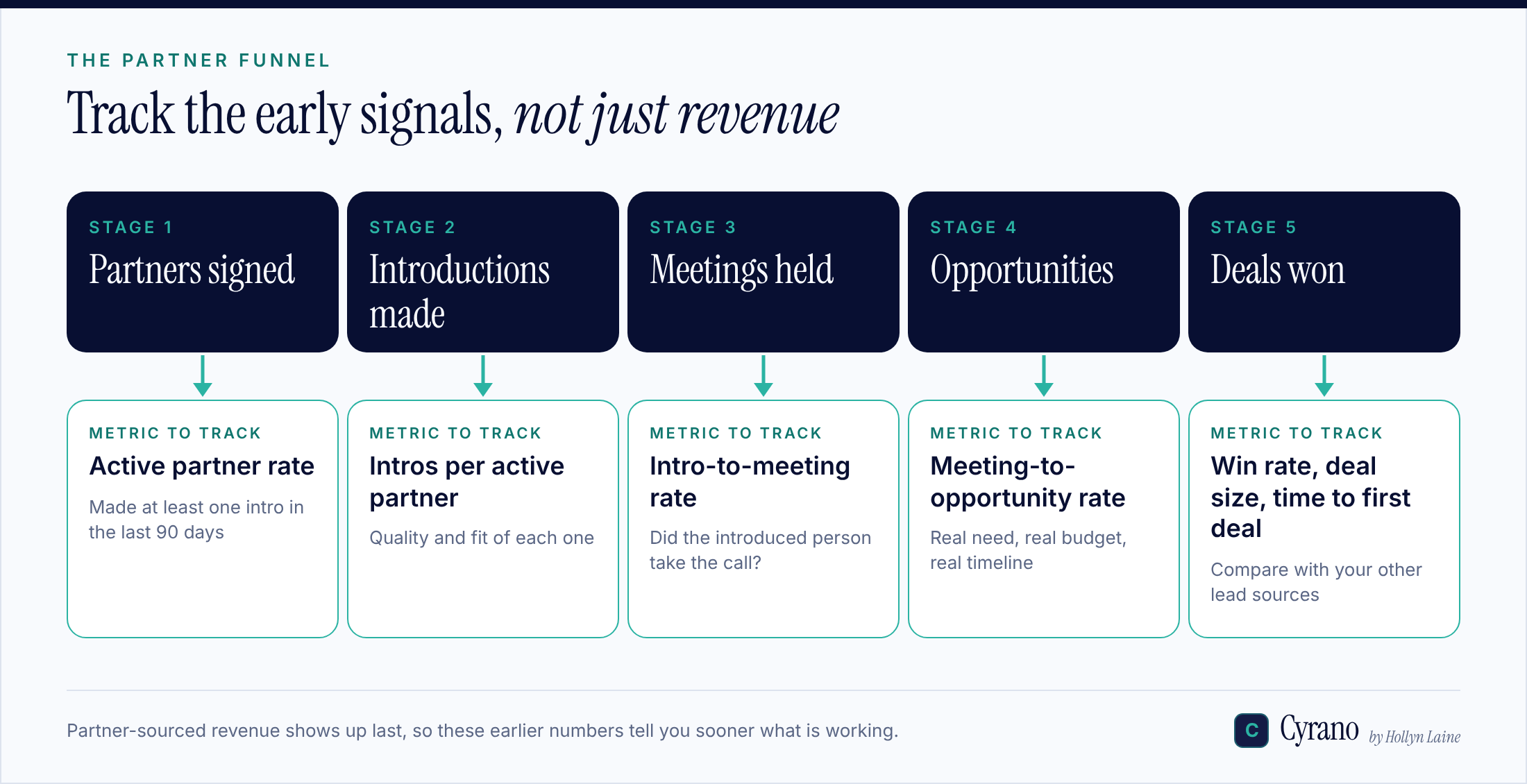
Compare partner-sourced deals against your other lead sources on win rate, deal size and sales cycle. That tells you whether this works for your business, which is better than leaning on industry averages. If your partner deals aren't closing faster or bigger, my first suspect would be fit.
What I'd do in the first 30 days
In week one, choose two partner types, write down who your ideal partner serves, and pull the names from your last twenty closed-won deals. In week two, build a list of about 25 companies, score them on the three criteria, and keep the top ten. Week three is for sending the first notes and booking calls. In week four, have the calls, make one introduction in each partner's direction, and agree on one small ask in return.
Don't be surprised if the first deal takes a few months. Partner-led pipeline starts slowly and gets steadier, and the first quarter is mostly about learning which partners are real.
Frequently asked questions
What is partner-led growth?
It's a go-to-market approach where a meaningful share of new customers comes through partners, meaning other companies that already have a relationship with your buyer. They might refer you, recommend you, or work deals alongside your sales team. The first conversation starts with someone your buyer already trusts.
How do you find referral partners?
Start with the people already around your customers. Look at who else shows up in your closed deals, ask your best customers who they rely on, and check the partner pages and event sponsor lists of adjacent vendors. Then score each candidate on audience overlap, complementary offer and deal size before you contact anyone.
How many referral partners do you need?
Fewer than you'd think. I'd start with five to ten you've scored well and worked with personally, because a small group you actively support will do more than a long roster you can't keep up with. In my experience a handful of partners ends up producing most of the results.
Should you pay referral partners?
Sometimes, but it isn't required. Some partners want a fee, some want reciprocal introductions, and some want neither. Check the rules for their profession first, since CPAs face disclosure rules on commissions and sometimes an outright ban. Write down what counts as a referral before the first one arrives.
How long does it take for a referral partner to send a deal?
Plan on a few months. The first weeks go to conversations and first introductions, and then a full sales cycle has to play out before anything closes. If a partner you've supported for several months hasn't made a single introduction, it's reasonable to move on.
A quick note on how we do this at Hollyn Laine. We introduce B2B companies to referral partners who already serve their buyers, using a network we've built over more than a decade, and Cyrano is the platform we made to score partner fit (the same three criteria above) and keep partner conversations organized. We guarantee the meetings and only invoice in months we deliver them, and one client saw $3M+ in qualified pipeline in the first 60 days. If you're curious, there's a two-minute product tour at usecyrano.ai.