Fractional VP of partnerships
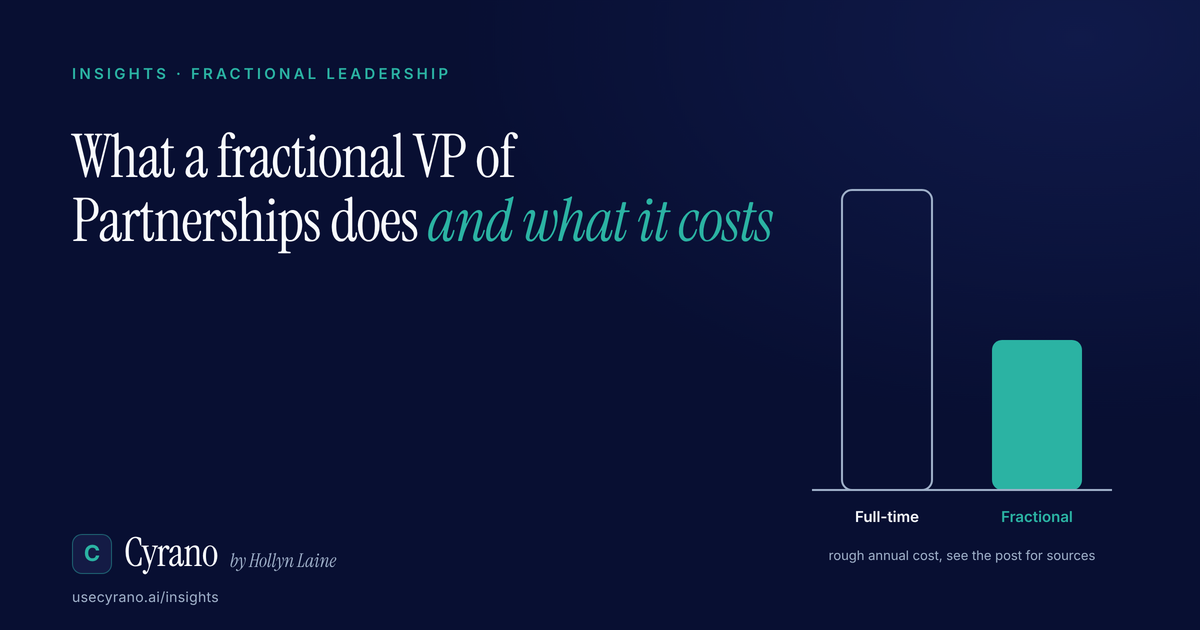
What a fractional VP of Partnerships does and what it costs
What a fractional VP of Partnerships actually does in the first 90 days, what the role costs compared with a full-time hire, and when it's the right call.
8 min read
Most companies I talk to already believe partners could be a real source of new business. Their best customers came in through an accountant, a broker or a consultant who vouched for them. The problem is that nobody owns it. The CEO does partnerships on Friday afternoons, a sales rep has a few friendly relationships, and the whole thing stays a side project.
The obvious fix is to hire a VP of Partnerships. The less obvious fix, and often the smarter first step, is to bring one in part-time. This post covers what a fractional VP of Partnerships actually does, what it costs compared with a full-time hire, and how to tell which one you need.
What is a fractional VP of Partnerships?
A fractional VP of Partnerships is a senior partnerships leader who works with your company part-time, usually on a monthly retainer, and owns the partner channel the way a full-time VP would. They set the strategy, pick which partners to go after, build the relationships, and answer for the results.
That last part is what separates them from a consultant. A consultant usually hands you a plan and leaves. A fractional VP stays and runs it. It's also different from hiring a partner manager, who is great at managing relationships someone else chose but usually isn't the person deciding where the channel should go.
The approach works across industries. A software company selling to HR teams, a law firm that wants more referrals from CPA firms, a wealth manager building relationships with estate attorneys, or an insurance broker working with fractional CFOs all face the same question: who does our buyer already trust, and how do we get introduced?
What they actually do in the first 90 days
The details depend on where you're starting from, but a good fractional VP's first quarter tends to follow a similar shape.
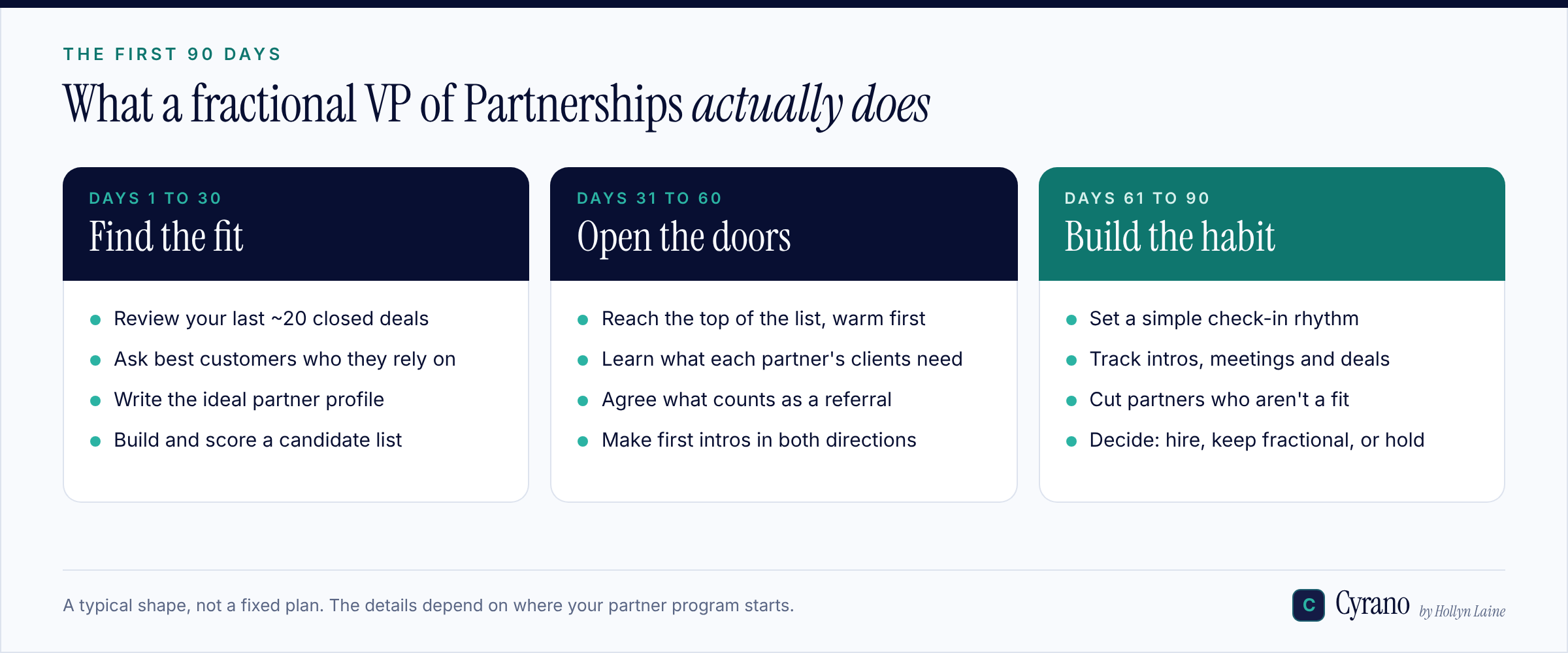
Days 1 to 30: find the fit. Look at your last twenty or so closed deals and figure out who else was involved. Talk to your best customers about who they rely on. Write down an ideal partner profile, build a list of candidates and score them on fit. Review any partner relationships you already have and decide which ones are worth keeping.
Days 31 to 60: open the doors. Reach out to the top of the list, ideally through a warm introduction rather than a cold note. Have real conversations about what each partner's clients need. Agree on a light structure for each relationship: what counts as a referral, who follows up, what each side gets. Make the first introductions in both directions.
Days 61 to 90: build the habit. Set up a simple rhythm for staying in touch, tracking introductions and reporting what's working. Cut the partners who aren't a fit. Decide with you whether the channel deserves more investment, and if so, whether that means a full-time hire, more fractional time, or staying where you are.
After that it's mostly steady work. Regular check-ins with active partners, a few new partners each quarter, co-marketing where it makes sense, and a monthly look at the numbers. I wrote more on the mechanics of picking and approaching partners in how to find referral partners who actually send deals.
What a full-time VP of Partnerships costs
Salary data for this role is thinner than for sales or marketing leaders, so I'd treat any single number with some caution. Here's what I could find and check.
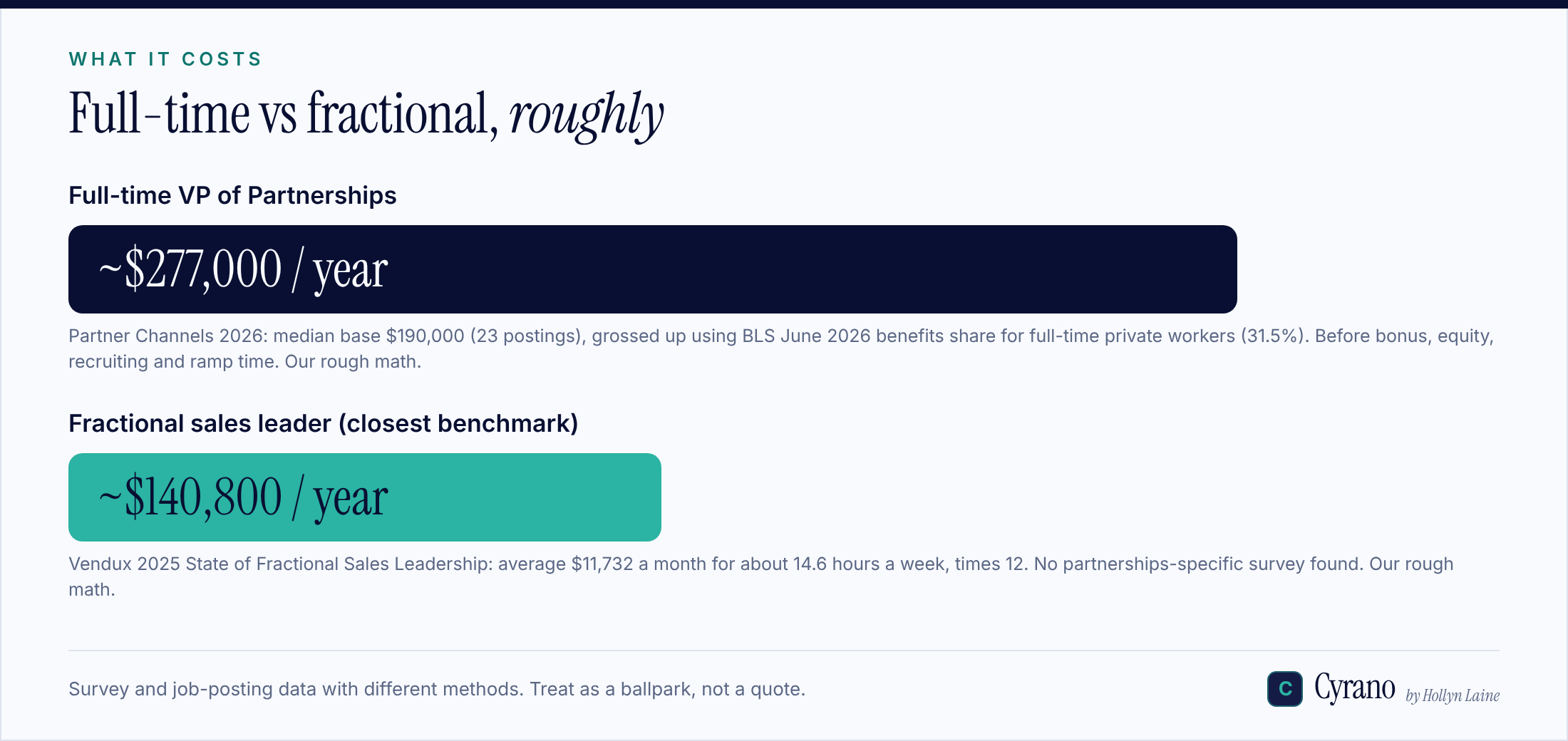
Partner Channels' 2026 analysis of VP of Partnerships job postings found a median base salary of $190,000 across 23 postings that disclosed pay, with a typical posted band of $183,000 to $231,000. That's a small sample, and it's base pay only, before bonus or equity.
Base salary isn't the whole cost. The Bureau of Labor Statistics reports that for full-time private industry workers in June 2026, wages and salaries made up 68.5% of employer compensation costs and benefits made up the other 31.5%. That's an average across all full-time workers, not executives specifically, so it's a rough guide. If you apply it to a $190,000 base anyway, our own back-of-the-envelope math puts the total at roughly $277,000 a year before any bonus, equity, recruiting fee or ramp time.
And ramp time matters. A new full-time leader has to learn your market and build relationships before partners start sending deals, so the first several months are mostly investment.
What a fractional VP of Partnerships costs
I couldn't find a survey that looks only at fractional partnerships leaders, so the closest benchmarks are fractional sales and executive roles. Partnerships work sits close to sales leadership, so I think that's a reasonable comparison, but it is a comparison.
- Vendux's 2025 State of Fractional Sales Leadership report, covering more than 1,000 assignments in the US and Canada, found an average of $11,732 a month ($225 an hour) for about 14.6 hours a week, with 88% of fractional sales leaders paid on a retainer. Vendux runs a network of fractional executives, and the data is self-reported.
- Fractional Jobs' 2026 Fractional Work Report found that VP-level and above fractional executives charge $223 an hour on average, and says a 10-hour-a-week engagement runs roughly half the fully loaded cost of a full-time hire.
At the Vendux average, twelve months of fractional sales leadership comes to about $140,800, which is our own math. Put next to the rough $277,000 full-time figure above, that's in the same neighborhood as the "about half" from Fractional Jobs.
Two things that comparison leaves out. A fractional leader gives you a part of a week, not all of it, so you're buying focus and experience rather than hours. And either way you'll need some budget for the partner work itself, like events, co-marketing and tools.
If you want to see how many partner-sourced deals it would take to cover the cost for your business, you can estimate your breakeven with our calculator.
When fractional makes sense, and when it doesn't
Fractional is usually a good fit when:
- You believe partners could work but haven't proven it yet, and you don't want to make a full-time executive hire on a hunch.
- Your partner channel is a handful of relationships that need a strategy and someone senior to open doors, not a large team to manage day to day.
- You need someone who already has relationships in your market, because building them from scratch takes years.
A full-time hire usually makes more sense when:
- Partners already drive a big share of revenue and the program needs someone every day.
- You're managing a team of partner managers, a large reseller program or complex technical alliances.
- Partnerships are central to the company's strategy and you want that person in every leadership meeting.
A common path is to start fractional, prove the channel, and then hire full-time with a much clearer picture of what the job is. A good fractional VP should be happy to help you write that job description.
Questions to ask before you hire one
- Who in our market do you already know, and can you give examples of introductions you've made in similar industries?
- What will you have done at 30, 60 and 90 days, and how will we measure it?
- How many hours a week, and how many other clients do you work with?
- Who does the day-to-day work between your sessions: you, us, or someone on your team?
- What tools and reporting do you bring, and what do you expect us to have?
- What happens to the partner relationships if we stop working together?
The last question matters more than people think. The relationships should belong to your company, not walk out the door when the engagement ends.
Frequently asked questions
What does a fractional VP of Partnerships do?
They own your partner channel part-time. That means choosing which partners to pursue, building those relationships, setting up how referrals and introductions work, and reporting on results. Unlike a consultant, they stay to run the program.
How much does a fractional VP of Partnerships cost?
There's no partnerships-specific survey I could find. The nearest benchmark, Vendux's report on fractional sales leaders, found an average of $11,732 a month for about 15 hours a week in 2025. Actual pricing depends on scope, hours and what's included.
Is a fractional VP of Partnerships cheaper than a full-time hire?
Usually, yes. Using the sources above, a full-time VP of Partnerships comes to roughly $277,000 a year including benefits, before bonus and equity, against roughly $140,800 for a year of fractional sales leadership at the Vendux average. You also avoid a long executive search.
How long does a fractional engagement usually last?
Vendux found the average fractional sales leadership assignment ran 9.7 months in 2025. For partnerships I'd plan on at least two quarters, because relationships take a while to start producing.
A quick note on how we do this at Hollyn Laine. We help companies win business through partners their buyers already trust, across HR and payroll, legal, accounting, wealth management, insurance and other B2B markets. Our Velocity tier is a Fractional VP of Partnerships with the full Cyrano platform behind them, and we keep it to three clients at a time so the work stays hands-on. The implementation fee is scoped to your setup and can be spread over 3, 6 or 12 months. If you'd like to talk about whether it fits, book a call and we'll walk through it together.