How to evaluate referral partners
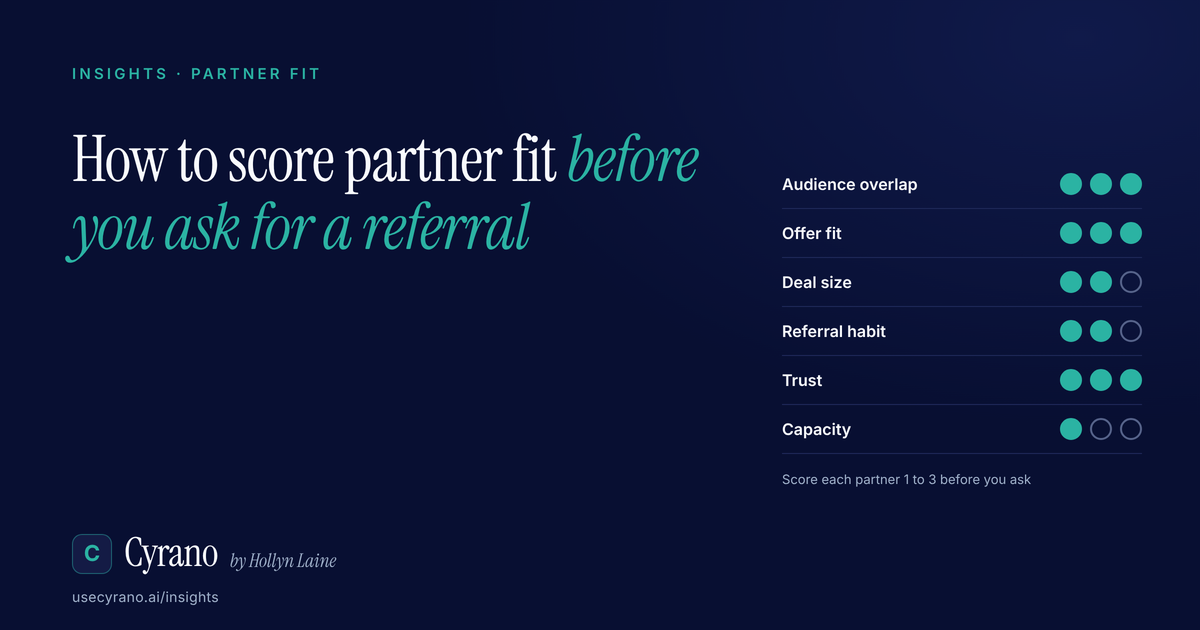
How to score partner fit before you ask for a referral
How to evaluate referral partners before you ask for an introduction: a simple scorecard for audience overlap, offer fit, referral habits, trust and capacity.
6 min read
Asking a partner for a referral spends something. It spends their time, a bit of their reputation with their client, and some of the goodwill between you. If the partner was never a good fit, you spend all of that and get nothing back, and they're less likely to say yes the next time.
So before I ask anyone for an introduction, I score them. It takes about fifteen minutes per partner, it saves weeks of chasing the wrong people, and it works the same way whether you're a software company working with PEOs, benefits brokers and advisors, a law firm looking for referrals from CPA firms, or a wealth manager building relationships with estate attorneys.
In the guide to finding referral partners I used a quick three-question version. This is the longer one I use when I'm about to make an actual ask.
Why fit matters more than enthusiasm
The most enthusiastic partner on the first call is often not the one who sends deals. Enthusiasm is easy to give. What makes a partner refer is that their clients regularly need what you do, they already have the habit of recommending people, and they trust you enough to put their name on it.
A partner who loves your product but serves a different kind of client will keep loving it and keep not sending you anyone. That's not their fault. It's a fit problem, and the scorecard below is meant to catch it before you've invested in the relationship.
The scorecard
I score six things, each from 1 (weak) to 3 (strong). The first three matter most, so I count them double.
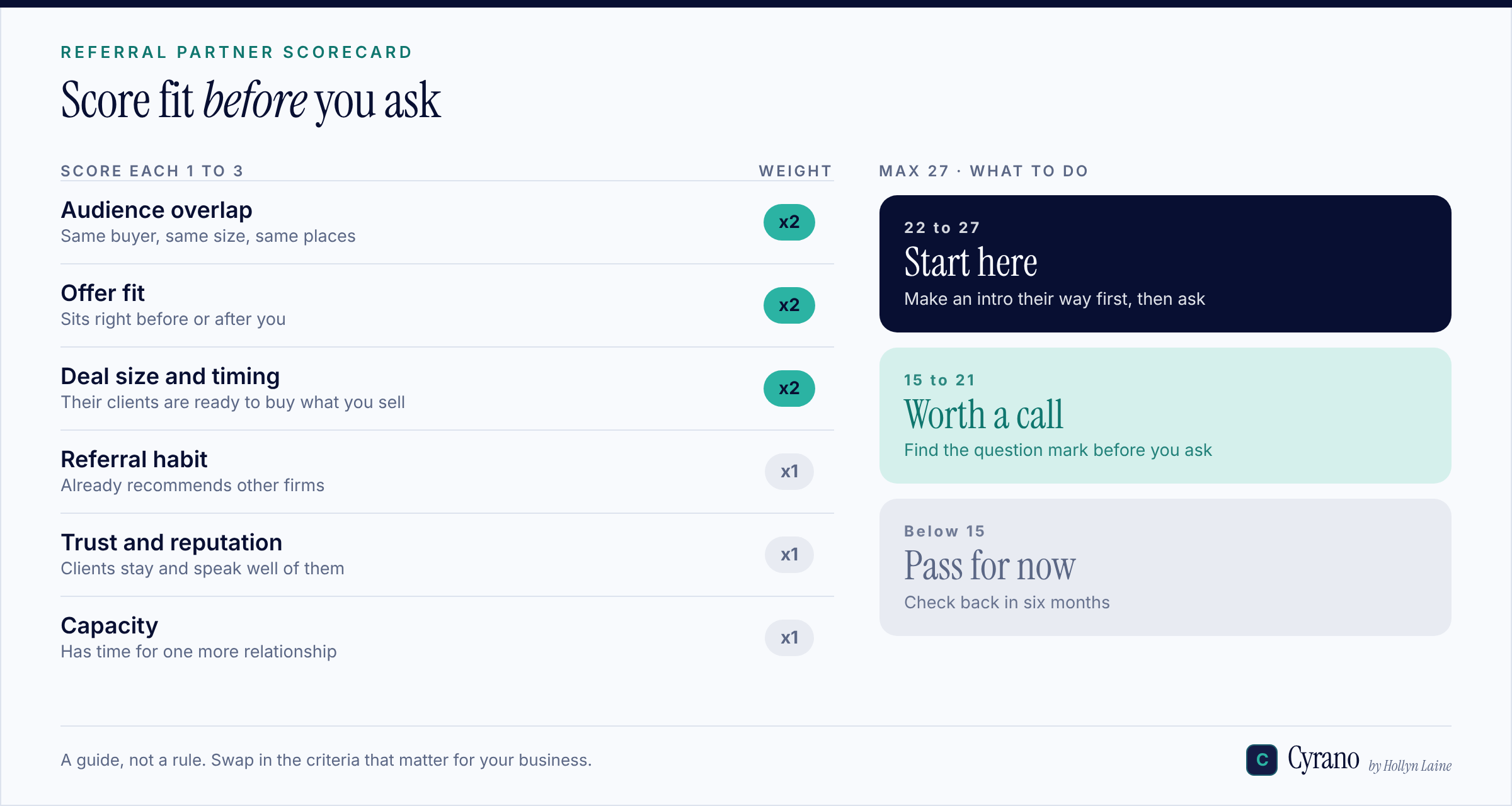
1. Audience overlap (counts double)
Do they serve the same buyer, at the same size, in the same places? Look at who they show off on their website, the case studies they publish and the events they go to. A benefits broker who mostly serves large employers is a weak fit for a product built for 30-person companies, however well you get along.
2. Offer fit (counts double)
Does what they sell sit naturally next to what you sell? The best partners do something that comes right before or right after you in the client's world. A CPA firm that cleans up a client's books is a natural neighbor for a fractional CFO. A firm that sells something close to yours is a much harder conversation, because a referral to you could cost them work.
3. Deal size and timing (counts double)
Are their clients ready to buy what you sell, at your price, when they talk to the partner? A partner who sees clients when they're starting out is a weak fit if you sell to companies that are already established, and the other way around.
4. Referral habit
Do they already recommend other vendors or firms to their clients? A partner who refers people every week just needs to add you to the list. A partner who has never referred anyone needs to build a new habit, which is a much bigger ask. You can usually find out by asking, "When a client asks you who to use for X, what do you tell them?"
5. Trust and reputation
How do their clients feel about them? Read reviews, look at how long their clients stay, and pay attention to how they talk about their clients on the first call. Their reputation becomes part of yours the moment they introduce you, so this one works in both directions.
6. Capacity
Do they have the time and the people to take on another relationship? A two-person firm in its busiest season may love you and still never get around to it. That's often a "not now" rather than a "no."
How to read the score
With the first three counting double, the maximum is 27.
- 22 to 27: Start here. Have a real conversation, make an introduction in their direction first, then ask.
- 15 to 21: Worth a call. Usually one of the criteria is a question mark. Find out which one before you ask for anything.
- Below 15: Pass for now. Keep in touch and check again in six months, since firms change.
The numbers are a guide, not a rule. I'd still pass on a high-scoring partner if something about how they treat their clients makes me uncomfortable, and I'd make an exception for someone with a middling score if they're the person everyone in the market goes to.
An illustrative example
This is a made-up example to show the scorecard in use, not a real firm or client.
A firm that sells to companies with 20 to 200 employees is looking at three potential partners. A regional CPA firm serving similar companies scores 3s on audience, offer fit and timing (18), with a 2 on referral habit, a 3 on trust and a 2 on capacity, for 25 in total. That's a start-here partner. A national advisory firm with large clients gets 1s and 2s on the double-weighted criteria and ends up at 14, so it's a pass for now. A local HR consultancy lands at 19, mostly because nobody is sure how often they refer, so the next step is to ask.
Red flags worth noticing
- They want a big referral fee before they've met your team or seen your work.
- They can't name a recent client who'd be a good fit for you.
- They sell something that overlaps with what you sell and haven't said how they'd handle it.
- They talk about their clients like a list to be sold to.
- They promise a lot of introductions on the first call.
None of these are automatic deal-breakers, but each one is worth a direct question before you ask for a referral.
Make the first ask small
Once a partner scores well, don't ask for a pile of leads. Ask for one warm introduction to a specific kind of client, write the note for them, and follow up quickly. Then tell them what happened. A partner who sees one introduction handled well is far more likely to send the next one.
And send something their way first if you can. The fastest way to show you're worth referring to is to refer someone to them.
Frequently asked questions
How do you evaluate a referral partner?
Score them on audience overlap, offer fit, deal size and timing, referral habit, trust and reputation, and capacity. Weight the first three most heavily, because a partner whose clients don't need what you sell won't refer, however much they like you.
What makes a good referral partner?
They serve the same buyer as you, sell something that sits naturally next to what you do, already recommend other firms to their clients, and are trusted by the people they serve.
How many referral partners should I score at once?
I'd score about 25 candidates and actively work with the top five to ten. A small group you support well will usually do more than a long list you can't keep up with.
A quick note on how we do this at Hollyn Laine. We help companies win business through partners their buyers already trust, across HR and payroll, legal, accounting, wealth management, insurance and other B2B markets. Cyrano scores each potential match with FitScore before we make an introduction, and our team uses a network built over more than a decade to make the introductions. If you'd like to see how it works, there's a two-minute product tour at usecyrano.ai.