HR tech partnerships
HR tech and payroll partnerships: how to work with PEOs, benefits brokers and advisors
How HR tech and payroll companies can build partnerships with PEOs, benefits brokers, accountants and HR advisors: who to approach, what they want, and timing.
10 min read
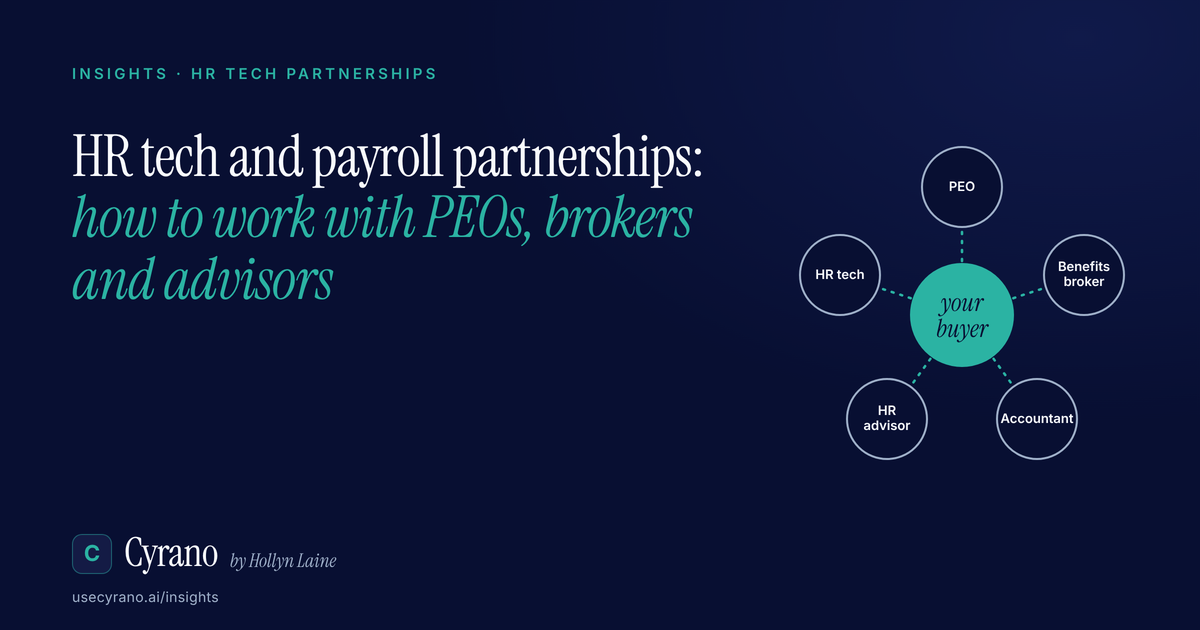
The best way to win business in most B2B markets is through people your buyer already trusts. A law firm gets recommended by the client's accountant. A wealth manager gets introduced by an estate attorney. A commercial insurance broker hears about a new client from a fractional CFO. HR tech and payroll is one of the clearest examples of this I know, because the buyer almost never makes the decision alone.
Think about the owner of a 40-person company deciding to switch payroll. They aren't reading comparison sites at midnight. They're asking their accountant, mentioning it to their benefits broker at renewal, or finding out their PEO already handles it. If you sell HR or payroll software to small and mid-sized businesses, those people are in the room whether you're talking to them or not.
This post is about how to work with them on purpose. I've spent a long time in this corner of the market, so I'll be specific, but the same playbook carries over to any industry where buyers lean on advisors.
Who is in the room when a small business buys HR or payroll
Before you reach out to anyone, it helps to map who influences the decision and why. For a payroll or HR platform selling to companies with roughly 10 to 500 employees, it usually looks like this.
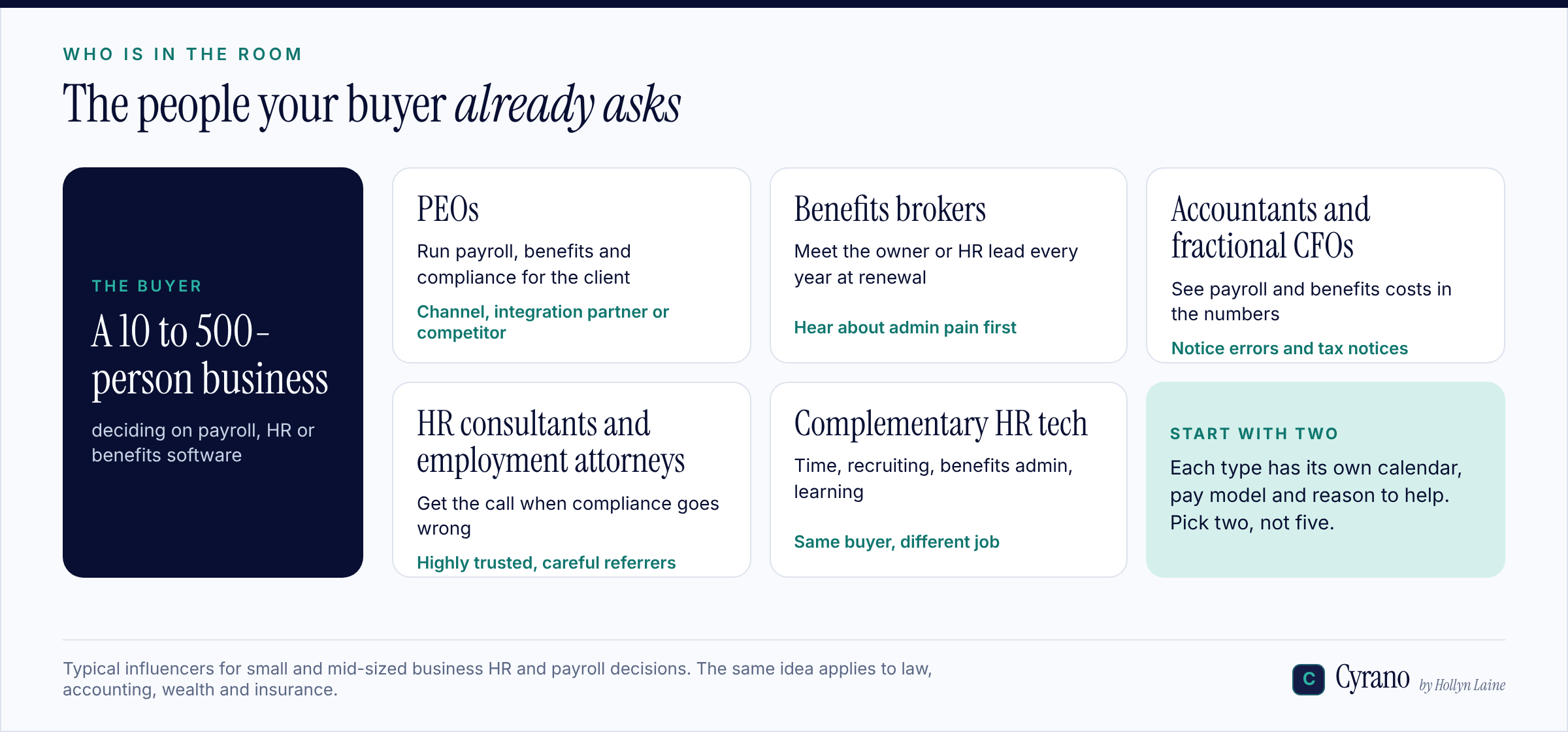
- PEOs. They run payroll, benefits and compliance for their clients, so they're either your channel, your integration partner or your competitor, depending on what you sell.
- Benefits brokers. They meet the owner or HR lead every year at renewal and hear about admin headaches before anyone else does.
- Accountants, bookkeepers and fractional CFOs. They see payroll errors, tax notices and benefits costs show up in the numbers.
- HR consultants and employment attorneys. They get the call when a handbook is out of date or a classification question turns into a problem.
- Other HR tech vendors. Time tracking, recruiting, benefits administration and learning platforms that sell to the same HR buyer but don't do what you do.
I'd pick two of these to start with, not all five. Each one has a different calendar, a different way of getting paid and a different reason to help you. I go deeper on choosing and prioritizing partner types in the guide on how to find referral partners who actually send deals.
Working with PEOs
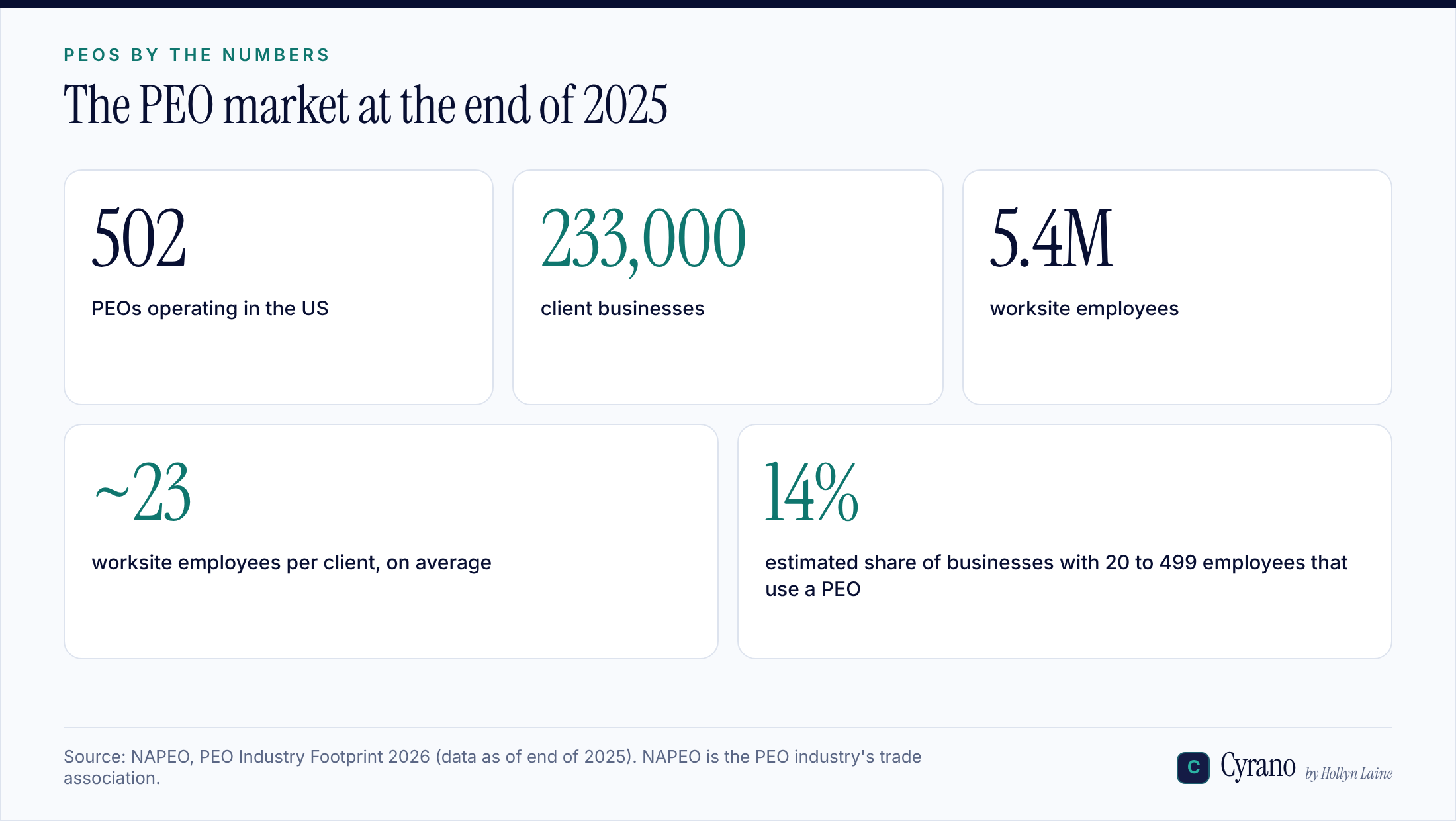
PEOs are a bigger slice of the small business market than a lot of HR tech founders realize. According to NAPEO's 2026 industry footprint research, 502 PEOs served 233,000 client businesses and 5.4 million worksite employees at the end of 2025. NAPEO estimates PEOs now reach about 14% of businesses with 20 to 499 employees, and the full white paper puts the average client at about 23 worksite employees. NAPEO is the PEO industry's trade association, so it has a point of view, but those are the most complete numbers I've found.
What that means for you depends on what you sell.
If your product overlaps with what the PEO already bundles, like core payroll, the PEO is mostly a competitor for the same client. There can still be a relationship. Companies sometimes outgrow the PEO model or want more control over their benefits, and a PEO that knows you're a good landing spot may point those clients your way rather than see them go somewhere worse. That's a slow, trust-based relationship, and it starts with being helpful, not with a pitch.
If your product fills a gap the PEO doesn't cover, like recruiting, performance, learning or a specialty benefit, the PEO can be a real channel. Here the conversation is about making their offer stronger. They want fewer support tickets, happier clients and something that helps them win against other PEOs. An integration, a simple co-branded one-pager for their sales team, and a named person on your side who picks up the phone will usually get further than a referral fee.
A few things I've learned about PEO conversations:
- Find out who owns vendor relationships. At a large PEO it might be a partnerships or product team. At a smaller one it's often the founder or head of sales.
- Expect a slower start than with a broker or an accountant. They're putting your product in front of their clients, so they'll want to see it work for a handful of them first.
- Be clear about who owns the client relationship and who gets the support call. Most friction later comes from not deciding that up front.
Working with benefits brokers
Benefits brokers are some of the best-connected people in the small business world, and some of the busiest. Their year revolves around renewals, and for many brokers the fall open enrollment season is the most packed stretch of the year. If you pitch a broker in the middle of it, you'll get ignored, and that's fair.
What brokers care about is keeping their clients and looking smart in front of them. A broker who introduces a client to a payroll or HR platform that makes enrollment smoother and cuts down on errors looks good. A broker who introduces a vendor that creates a mess looks bad, and they'll remember it.
So the pitch to a broker is less "send us leads" and more "here's how we make your clients easier to serve." A few things that tend to work:
- Show them how your product handles the things that make their job harder, like enrollment data, eligibility changes and carrier connections.
- Offer to help one of their clients with a real problem before you ask for anything.
- Ask what their clients complain about. Brokers hear a lot, and the answer tells you whether you're a good fit.
On compensation, ask rather than assume. Some brokers are happy with reciprocal introductions, some expect a referral fee, and some work under rules or firm policies that limit what they can accept. Write down what counts as a referral and what happens when one closes before the first introduction arrives, not after.
Working with accountants, fractional CFOs and HR advisors
Accountants, bookkeepers and fractional CFOs often notice payroll and benefits problems before the client does. A payroll tax notice, a reconciliation that doesn't add up, benefits costs creeping up month after month. Those are natural moments for an introduction, and an advisor who sees the numbers every month is a strong source.
Two things to keep in mind:
- Professional rules. CPAs in particular face disclosure rules on commissions and referral fees, and in some situations can't accept them at all. Don't make a fee the center of the relationship. Lead with reciprocity and usefulness. The pillar guide covers this in more detail.
- Their calendar. Tax season isn't the time to start a new partnership with an accounting firm. Late spring and summer conversations go a lot better.
HR consultants and employment attorneys are smaller in number but very trusted. When a client calls them about a compliance problem, the fix often involves better systems. A short, honest explanation of what your product does and doesn't do is worth more to them than a polished deck, because they'll be careful about putting their name behind anything.
An illustrative example
Here's how this might look in practice. This is a made-up example, not a client.
A payroll platform that sells to companies with 20 to 150 employees decides to start with two partner types: regional benefits brokers and fractional CFO firms. In the first month it pulls its last twenty closed deals and finds that a broker or an outside accountant came up in about a third of them. It reaches out to five brokers and three CFO firms that showed up more than once, asks what their clients struggle with, and makes one useful introduction in each partner's direction before asking for anything back.
By the end of the quarter, two brokers and one CFO firm are sending occasional introductions, and the rest are friendly but quiet. That's a normal result. The useful thing is knowing which three to invest in next quarter.
Timing matters more than people expect
Every partner type in HR and payroll runs on a calendar, and fitting into it is one of the easiest wins available.
- Benefits brokers: avoid the open enrollment rush. Reach out after it, when they're thinking about next year.
- Accountants and CPA firms: avoid tax season. Year-end payroll and W-2 issues, though, can be a natural reason for an introduction.
- PEOs: build relationships ahead of their own planning and budgeting cycle, since adding a vendor is a decision they'll want to think through.
- Payroll and HR switches: many companies prefer to change systems at the start of a quarter or a new year, so introductions that land a few months ahead of those dates have room to turn into deals.
How to tell if it's working
Track partner-sourced deals separately from everything else, and compare win rate, deal size and sales cycle against your other lead sources. Partner-involved deals often look better, and there's some outside data on it. In a Crossbeam and Pavilion survey of revenue leaders, ecosystem-led deals were reported as 49% more likely to close, with a 48% higher annual contract value. That's self-reported survey data from a company that sells partner software, so treat it as a direction, not a promise. Your own numbers after two quarters will tell you more. I wrote about what the data says and doesn't say in warm introductions vs cold outbound.
If partner deals aren't closing better than your other channels, look at fit first. Usually the partners are fine people serving a slightly different buyer.
Frequently asked questions
What is an HR tech partnership?
It's a working relationship between an HR or payroll software company and another company that serves the same buyers, such as a PEO, a benefits broker, an accountant or another HR tech vendor. The partner might refer clients, integrate with your product, or work deals alongside your team.
Should a payroll company partner with a PEO?
It depends on how much your products overlap. If you offer something the PEO doesn't, the PEO can be a strong channel. If you do the same core job, the relationship is more about being the place their clients land when they outgrow the PEO model, and that takes longer to build.
Do benefits brokers expect referral fees?
Some do and some don't, and some work under rules or firm policies that limit what they can take. Ask early, keep it simple, and put what counts as a referral in writing before the first introduction.
Is this only for HR tech?
No. The same approach works anywhere buyers rely on advisors: law firms, CPA firms, wealth managers, insurance brokers and more. HR and payroll is just a market where the advisors are especially easy to spot.
A quick note on how we do this at Hollyn Laine. We help companies win business through partners their buyers already trust, in HR and payroll as well as legal, accounting, wealth management, insurance and other B2B markets. We use a network we've built over more than a decade to make the introductions, and Cyrano is the platform that helps us score partner fit and keep every partner conversation organized. If you'd like to see how it works, there's a two-minute product tour at usecyrano.ai.