Reactivate inactive referral partners
How to reactivate a quiet referral partner
How to reactivate inactive referral partners in B2B: find out why they went quiet, reach out with something useful, make one small ask, and keep them active.
9 min read
Almost everyone who has worked with referral partners has a few of these. A firm that sent you two great introductions last year, maybe three, and then nothing. Nobody fell out and there was never an awkward conversation. They just went quiet, and every month that passes makes it feel a little stranger to pick up the phone.
Winning business through partners your buyers already trust works the same way in almost every industry, whether you sell HR or payroll software, run a law firm that gets referrals from CPA firms, or you're a wealth manager who used to hear from an estate attorney every quarter. And in all of them, a quiet partner is usually one of the easiest relationships to bring back. They already know you, they've already trusted you with a client, and their clients still have the problems you solve.
If you search for how to reactivate inactive partners, most of what comes up is about affiliate programs: tracking links, commission bumps and email sequences to hundreds of publishers. B2B referral partners are a different animal. You usually have a handful, each one is a real relationship, and the reasons they go quiet have little to do with commission rates. If you're still building your list, start with how to find referral partners who actually send deals and come back to this one later.
Why referral partners go quiet
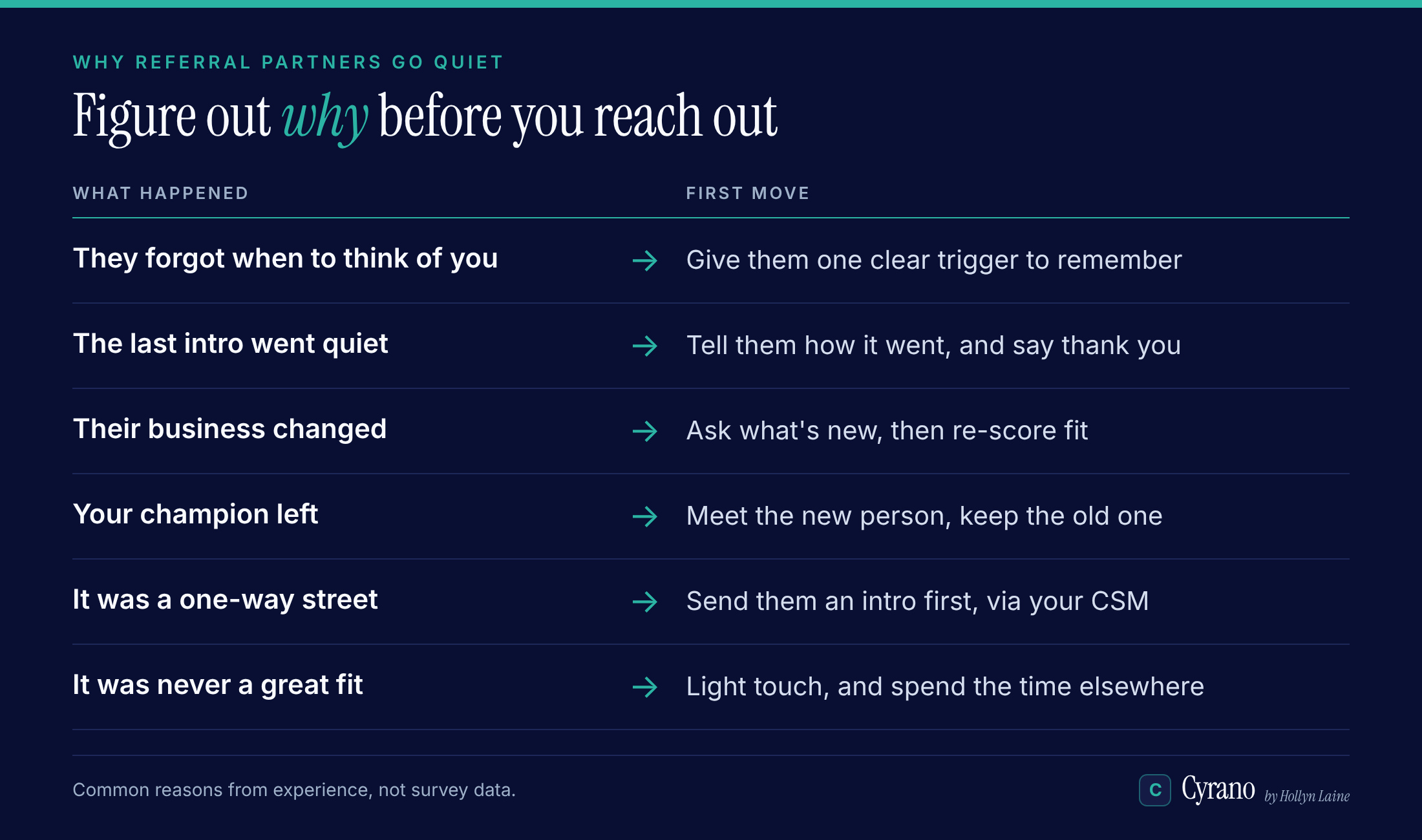
In my experience it's rarely because they stopped liking you. It's almost always one of these:
- They forgot when to think of you. They know what you do, but nobody gave them a clear moment to bring you up.
- The last introduction went sideways, or they never heard what happened. A partner who hears nothing back assumes it went nowhere, or worse.
- Their business changed. New services, a different client mix, a merger, a busy season that never ended.
- Your champion left. The person who referred you moved on, and nobody else at the firm knows who you are.
- It was always a one-way street. They sent you clients and you never sent anything back.
- It was never a great fit. Some partners send one deal by luck and were never going to send a second.
Most of these are fixable, and the fix is different for each, so it's worth ten minutes to figure out which one you're dealing with before you send a generic "just checking in" email. With partners like benefits brokers and PEOs, for example, a long quiet stretch in the fall might simply be renewal season and have nothing to do with you.
Before you reach out, figure out why
Pull up whatever you have on the partnership and answer a few questions honestly. When did they last send an introduction, and did you tell them how it turned out? Have you ever sent anything their way? Is the person who used to refer you still there? And do they still serve the same kind of client you do?
That last one matters more than people expect. Firms drift. Before you put effort into bringing a partner back, score their fit again with fresh eyes. A partner who scored well two years ago may have moved upmarket or started offering something close to what you sell. If the fit is gone, a lighter touch is kinder for both of you.
Why it feels more awkward than it is
The hesitation most of us feel before reconnecting is mostly in our own heads, and there's some decent research on that. Researchers Daniel Levin, Jorge Walter and Keith Murnighan have studied what happens when executives reconnect with "dormant ties," people they haven't been in touch with for three years or more. In their first study, described in MIT Sloan Management Review, the advice executives got from those old contacts was as useful as the advice from their current relationships, and often more useful. In a follow-up study of 156 executives, also in MIT Sloan Management Review, 94% of reconnections produced at least some valuable advice. Many of the executives were anxious beforehand, and afterward 90% said they enjoyed it, 6% were neutral and only 4% didn't.
A separate set of experiments led by Peggy Liu at the University of Pittsburgh, with more than 5,900 participants, found that people consistently underestimate how much others appreciate being reached out to, and that the gap is bigger when the contact is a surprise or the relationship is a looser one, according to the American Psychological Association's summary of the study. In one of those experiments, as The Guardian reported, senders guessed their note would be appreciated at 5.57 on a seven-point scale, and recipients actually rated it 6.17.
I'd be careful about stretching any of this. These studies are about asking old contacts for advice and reaching out to people in your social circle, and nobody measured referral partners specifically. They do match what I've seen, though. When I call a partner I haven't spoken to in a year, they're almost always glad to hear from me, and the worry beforehand was usually wasted energy.
Lead with something useful
The first message back shouldn't be an ask. It should give them a reason to be glad you called. A few that work well:
- Close an old loop. "I realized I never told you how things went with the company you sent us last spring. They're still with us and doing well, and I wanted to say thank you properly." It costs nothing and fixes the most common reason partners go quiet.
- Send them an opportunity. If one of your clients needs what they do, offer the introduction. In my experience, sending a referral their way is the quickest way to get things moving again.
- Share something you've learned about their clients. A pattern you're seeing, a question that keeps coming up, a change that affects the people you both serve.
Keep it short and write it like a person. If your old contact has left, reach out to them at their new firm anyway and ask who at the old firm you should know.
When you're introducing one of your clients, start with your CSM
If your way back in is introducing one of your clients to the partner, don't send it straight from sales. The person who knows that client best is usually your customer success manager. They've built trust with that client day to day, the kind sales can't really touch, and the client hears the idea differently coming from them.
So the fit note goes to the CSM first: who the partner is, why they might help this particular client, and what the client would get out of it. The CSM checks with the client, and only then does the introduction happen. It's a little slower, and it means the partner gets an introduction the client actually wants, which is exactly the impression you're trying to make.
Make one small, specific ask
Once you've reconnected and given something first, ask for one warm introduction to one kind of client, with a clear trigger they can remember. Something like, "If a client mentions they're about to open a second location, that's usually when we can help." That works better than a description of what you do, because it tells them when to think of you.
Write the two-sentence blurb for them, answer fast when something comes in, and tell the partner what happened, whatever happened.
An illustrative example
This is a made-up example to show how it fits together. It's not a real firm or client.
A small accounting firm used to send a fractional CFO practice about one client a quarter, then nothing for nine months. Looking back, the CFO practice realized the last introduction had become a long engagement and nobody had ever told the accounting partner, who had also been buried in tax season.
So the CFO practice waited for the season to end, sent a short thank-you note with an update on the client, and mentioned that one of their own clients was looking for a new accounting firm. Their CSM checked with that client first, the client said yes, and the introduction went to the accounting firm a week later. On the follow-up call, the CFO practice asked for one thing: to be mentioned when a client starts talking about raising money or buying a business. The next referral showed up about six weeks later.
Know when to let a partner go
Some quiet partners should stay quiet. If you've reconnected, given something first, made a small ask, and a couple of months later there's still nothing, move them to a lighter touch. Share something useful once or twice a year and spend your real time on partners who are engaged. Firms change, and some of these come back on their own.
Keep them from going quiet again
Most of what brings a partner back also keeps them from drifting in the first place. Close the loop on every introduction, send something their way when you can, and keep a light cadence with your best partners, something like thirty minutes a month. And notice early. A partner who used to send something every quarter and hasn't in six months is worth a call now, while it still feels natural.
If you have more partners than you can keep up with, that's usually a sign you need someone to own the relationships, whether that's someone on your team or a fractional VP of Partnerships.
Frequently asked questions
How do you reactivate an inactive referral partner?
Figure out why they went quiet first, then reach out with something useful: an update on their last introduction, a referral in their direction, or something you've learned about their clients. Once you've reconnected, ask for one specific introduction with a clear trigger, and close the loop on what happens.
How long before a referral partner counts as inactive?
There's no standard number. I compare a partner against their own pattern. If someone who used to send an introduction every quarter hasn't sent one in six months, that's worth a call.
Should I offer a bigger referral fee to win a partner back?
Usually that isn't the problem. B2B referral partners mostly refer because it helps their clients and makes them look good. A partner who went quiet more often forgot when to think of you, didn't hear what happened last time, or saw their business change. Fix that first.
Is it better to call or email a quiet partner?
A short note to open the door, then a call. In the MIT Sloan Management Review follow-up study, executives rated face-to-face reconnections as more valuable than phone conversations (5.63 versus 5.29 on a seven-point scale), so if you can meet in person, even better.
A quick note on how we do this at Hollyn Laine. We help companies win business through partners their buyers already trust, across HR and payroll, legal, accounting, wealth management, insurance and other B2B markets. Cyrano scores each potential match with FitScore, and the fit note goes to the client's CSM first, before any introduction happens. Our team uses a network built over more than a decade to make the introductions. If you'd like to see how it works, there's a two-minute product tour at usecyrano.ai.